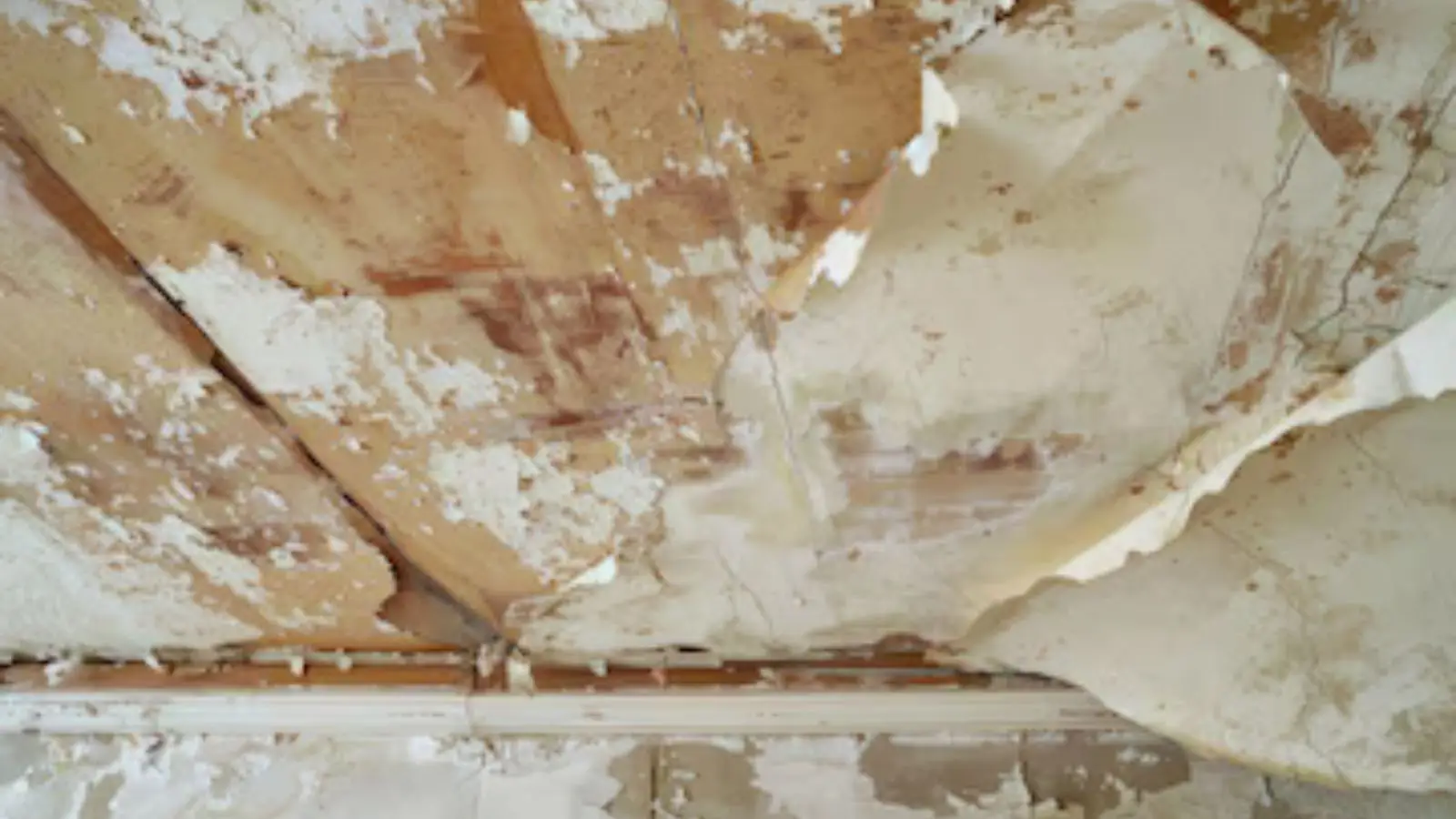
Water damage usually looks like a discolored stain, often yellow or brown with a darker ring at the edge, plus paint that bubbles or peels, drywall that feels soft, floors that cup or buckle, trim that warps, and a musty smell. Some signs are loud and some are quiet. The tricky part is telling an old, dried stain from a leak that is still active, and that takes more than a glance.
Start with the ceiling and walls
Ceilings show water first because water runs down and pools above the drywall. A tan or brown stain with a ring around the edge often means a leak that has wet and dried more than once, since each cycle leaves another ring. A fresh, damp stain with no clear edge is usually recent.
On walls, look for paint bubbles, peeling, hairline cracks and a chalky white residue. Drywall that sags, crumbles or feels spongy when you press it has been wet long enough to lose strength. Baseboards that lift away from the wall or swell at the bottom point to water at floor level.
Read the floor
Floors tell you how long and from which direction the water came. Hardwood that cups, where the edges rise higher than the center, usually means moisture from below. Crowning, where the center rises, can mean the surface got wetter than the bottom. Boards that gap or buckle off the subfloor point to a larger soak.
Laminate swells at the seams and turns lumpy. Vinyl plank may lift at the edges. Carpet that feels cold or damp underfoot may have a wet pad beneath it, and a pad holds water long after the surface seems dry.
The sign-by-sign guide
| Sign | What it usually means | What to do next |
|---|---|---|
| Brown stain with darker ring on a ceiling | Repeated wetting from a roof or plumbing leak above | Find the source, then have it checked with a moisture meter |
| Bubbling or peeling paint | Moisture trapped behind the paint, often in drywall | Repainting hides it, so check what is behind it first |
| Soft or crumbling drywall | Long or heavy exposure to water | Treat as damaged, plan for removal and drying |
| Cupped hardwood | Moisture reaching the boards from below | Find the source, avoid sanding until the wood is dry |
| Buckled laminate or lifted vinyl | Water got under the planks or seams | Lift a section to see the subfloor, and dry it |
| Warped or swollen baseboards | Wet wall base or floor-level water | Check for moisture in the wall cavity |
| Musty or earthy smell | Hidden dampness, often behind finishes | Look for the damp area and have it measured |
| Cold, damp carpet | Wet pad, sometimes wet subfloor | Peel back a corner, photograph, call for extraction |
| White crust on masonry | Moisture moving through concrete or brick | Check the outside grading and gutters |
| Dark spots that look like growth | Mold growing on a damp surface | Find the moisture and call a pro, do not scrub dry |
What color and rings mean in general
Yellow or tan stains are common for water carrying dust and tannins from framing. Darker brown rings suggest repeated wetting. Black or gray patches may be mold growing on a damp surface, though you cannot diagnose growth from color alone. Rust streaks around a ceiling fixture or fastener point to water traveling along metal.
Color helps you decide where to look, but it does not tell you whether the water is still there. A ring can stay on a ceiling for years after the leak is repaired.
Old stain or active leak?
A dry stain can still look alarming, and a hidden active leak can look like nothing at all. Your fingertip is a poor tool. It can detect cool, soft or damp surfaces, but it cannot measure moisture inside a wall.
A moisture meter reads moisture in drywall, wood and concrete, and a thermal imaging camera shows temperature differences that often reveal wet areas behind a finished surface. A reading that is high now, or a stain that grows or darkens after rain or after you run a fixture, points to an active source. A stain whose readings are normal and whose edges have not moved over several weeks is usually old.
Take a pencil mark around the edge of a stain and photograph it with a date. If it moves, the source is live.
Plumbing leak or roof leak?
Timing is the clue. A stain that grows during or just after rain, especially near an exterior wall or under the roof, points to the roof, flashing or siding. A stain that appears under a bathroom, kitchen or laundry room, or that grows when someone uses water upstairs, points to plumbing.
Stains near an air handler or beneath an attic unit can come from a clogged condensate line. Pipe leaks inside walls tend to leave a vertical stripe or a damp spot at a consistent height.
A short checklist for a suspected leak
Look in the right places
Check under sinks, around toilets, behind the washer and below the water heater.
Press and sniff
Soft drywall and a musty smell both suggest hidden moisture.
Mark and photograph
Outline the stain with a pencil and add the date.
Test after rain or fixture use
See whether the stain grows when water is on or when it rains.
Get it measured
A moisture meter and thermal camera confirm what the eye cannot.
When it needs a professional
Call a restoration professional when you find soft drywall, a spreading stain, a smell that returns, wet carpet or a ceiling that sags. Mold needs moisture, and it can begin on damp materials in about 48 hours, so a quiet leak is worth acting on.
Our water mitigation crews use meters and a thermal imaging camera to map what is wet, and our water damage cleanup service covers removal of what cannot be saved. If a sagging ceiling looks like it may collapse, stay out of the room, and call (339) 333-9345 from somewhere safe.
If water touches outlets or fixtures, or you smell gas or sewage, leave the area and call the utility or 911 before you call a restoration line.
Where you live in Stoneham matters for the questions you ask
Stoneham has Spot Pond, the Middlesex Fells Reservation and Stone Zoo among its landmarks, and many homes sit close to that open land. Living near water and wooded ground does not tell you what is behind your wall. The practical step is the same for every 02180 address: check the FEMA flood map for your address, and keep an eye out for damp basement walls and grading that slopes toward the house.
Nearby towns
If you are comparing signs in a neighboring home, our pages for Woburn and Medford describe how dispatch works in those areas.
Frequently asked questions
What does early water damage look like?
Early damage can be subtle: a faint yellow stain, a small paint bubble, a slightly soft spot in drywall, a musty smell or a baseboard that sits proud of the wall. Press the area, look for a darker edge, and have a moisture meter check anything that feels damp.
How can I tell if a water stain is old?
An old stain has a dry, clearly defined edge that has not moved over weeks, and a meter reads normal. A recent or active one looks damp, feels cool, grows or darkens after rain or use of a fixture. A meter reading is more reliable than touch.
Does a brown ring always mean mold?
No. Brown rings are usually from water carrying stain from the materials it passed through. Mold looks like fuzzy, spotty or dark growth and needs moisture to live. You cannot diagnose it from color, so have the damp area found and measured before anything is scrubbed or painted.
Why is my hardwood floor cupping?
Cupping usually means the underside of the boards is wetter than the top, often from a leak, a damp crawl space or a basement below. Find and stop the source first, because the boards need time to dry before any repair decision is made.
Where can I check whether my Stoneham address is in a mapped flood area?
Check the FEMA flood map for your address, using your street address in the 02180 ZIP. The map shows mapped flood hazard areas, and it is a good first stop before you ask your insurer about flood coverage. A map does not tell you whether a wall stain is a roof leak or a plumbing leak.