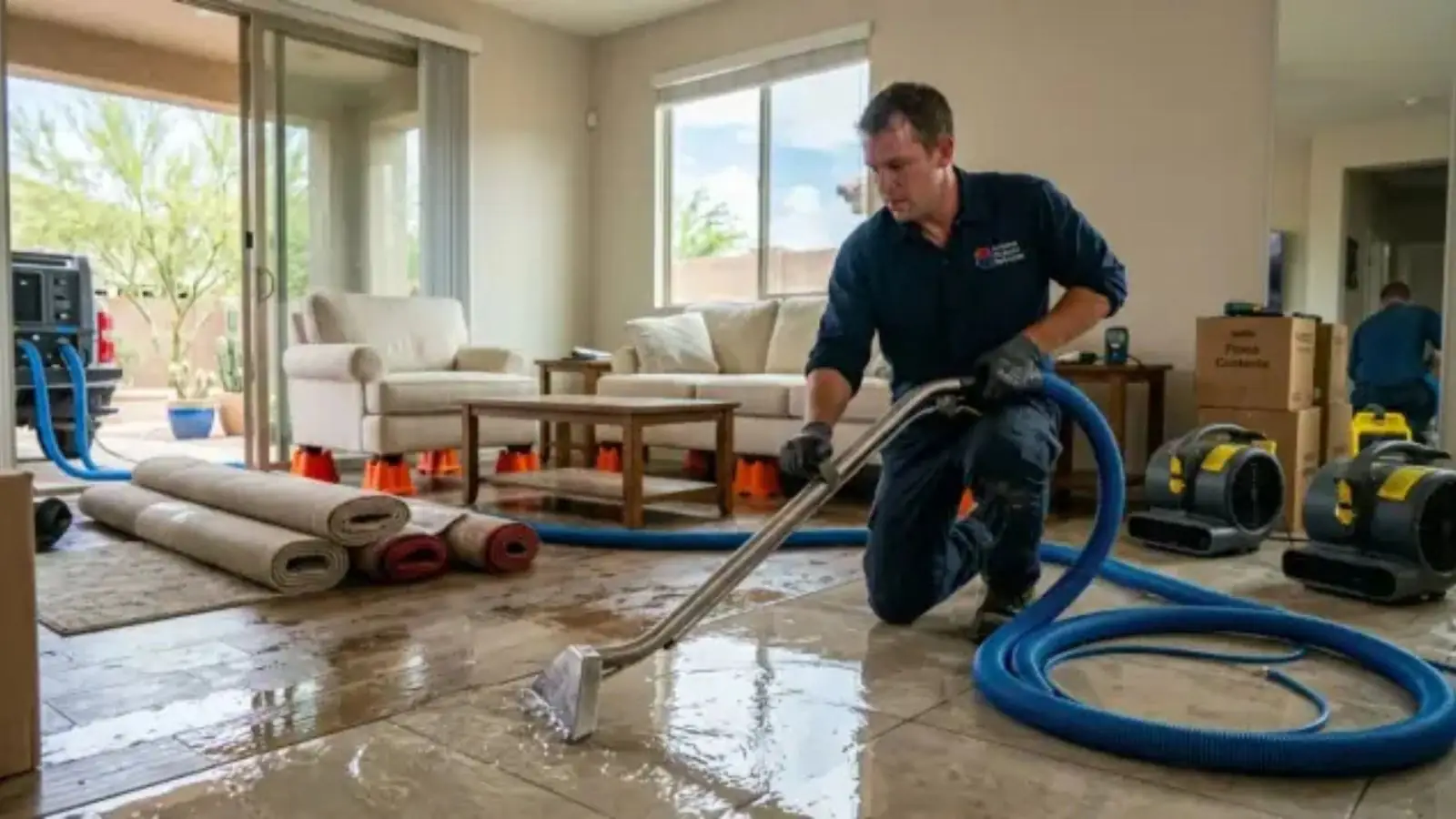
Standing water is an emergency because it keeps soaking into whatever it touches. Call the dispatch line any hour, since it runs 24/7. While you wait, find and stop the source if it is safe, shut the main water valve, and keep people and pets out of the water. Lift valuables, shoes, boxes and electronics out of reach, and cut power to wet areas only if you can reach the panel while dry.
We do not promise an arrival time, but same-day service is available when a crew is open, and nights and weekends are handled the same way.
Standing water right now: what to do and what to avoid
Once water sits more than a few inches deep, treat it as unsafe until proven otherwise. It may be touching outlets, a furnace, a water heater or a panel, and it may carry sewage or runoff. Do not wade in with bare feet, and do not run a household vacuum or any plugged-in appliance through it.
Do not try to bail a flooded basement all at once. Removing water too fast from a basement with saturated ground outside can stress walls and floors. A crew works in stages, watches the levels and uses pumps sized for the job.
Electrical safety comes first
Stay out of any room where water is touching outlets, cords or the electrical panel. Cut power only if the panel is reachable while you stand on dry ground. For any electrical or gas risk, such as sparking, buzzing, a gas smell or a flooded panel, leave the building and call the utility or 911 before calling the restoration line.
Burst pipe water damage
A burst pipe puts a lot of water on the floor in a short time, so speed matters more than anything. Go straight to the main shut-off valve, which is usually near where the water line enters the house, often in a basement, utility room or garage. Turn it fully closed, then open a low faucet to drain what is left in the lines.
Some of the most common scenarios are plain ones: a washer valve that snaps behind the machine, a supply line that fails under a sink and floods the cabinet, or a frozen pipe that splits in an exterior wall. Pipes behind walls matter because water runs down inside the cavity for hours before anything shows, soaking insulation and drywall from the inside.
Extraction removes the visible water first, then crews use moisture meters and a thermal imaging camera to find where the rest traveled. Once the supply is off and the standing water is out, the structure still has to be dried, which is covered under water mitigation. A plumber has to repair the pipe itself, and we do not do plumbing.
What extraction equipment does
Different water levels need different tools. Crews match the equipment to the depth, the floor type and the layout of the space.
| Equipment | What it does | When it is used |
|---|---|---|
| Submersible pump | Moves large volumes of deep water out through a hose | Basements and rooms with several inches or more of standing water |
| Truck-mounted or portable extraction unit | Uses strong suction to pull water from carpet, pad and hard floors | Wet carpet, flooring and remaining water after pumps |
| Weighted extraction wand | Presses water out of carpet and pad | Soaked carpet that can be saved |
| Wet vacuum | Collects small pools and edge water | Tight corners, stairs and shallow water |
| Air movers | Move air across wet surfaces to start evaporation | After the water is out, as drying begins |
A crawl space or low area holding water
Crawl spaces and low corners of a basement hold water longer than anyone expects, because water has nowhere to go and the air is still. A crew may need protective gear, a small submersible pump and extra lighting to work in a low space safely.
Take photos of the water line and any stains on the foundation walls and joists. If the water comes back after it is pumped out, the cause is outside the house, and that is a drainage problem. Restoration is not basement waterproofing, so a contractor who handles grading or drains should look at that.
How scope and price are explained before work starts
A crew begins with a walk-through of the wet areas and checks the depth, the water category and the materials involved. Moisture readings show how far water spread past what you can see.
You get a written scope listing the extraction, any removals and the equipment planned. Price follows from that scope, and the crew can explain each line. If a pump runs longer than planned because water keeps seeping in, that is discussed with you instead of added quietly.
What drives the cost
Water category
Clean water (category 1) is the simplest. Category 2 and 3 water needs protective gear and more careful disposal.
Affected area
Depth, square footage and how many rooms are under water set the labor and pump time.
Materials
Carpet, pad, hardwood and drywall all hold water differently, and some must be removed.
Drying days and equipment
Air movers and LGR dehumidifiers that follow extraction run for several days.
Rebuild scope
Extraction does not include replacing flooring, drywall or trim. Those repairs are a separate phase.
Sudden and accidental water damage is often covered by homeowner policies, while gradual leaks and neglect often are not, and flood damage is usually excluded without separate flood coverage. Check your policy or ask your insurer. To get a number that fits your situation, call (339) 333-9345 and tell us how deep the water is.
Repairs and the Building Department
After a pipe is repaired, rebuilding may involve walls, flooring or plumbing work. The Stoneham Building Department at 35 Central Street accepts permit applications through the town's online portal, and the town says to call the office for inspections. Ask the department whether your repair needs a permit before work begins, and see water damage repair for how the rebuild is handled.
Frequently asked questions
Do you handle water removal emergencies at night or on weekends in Stoneham?
Yes. Dispatch answers around the clock, including nights, weekends and holidays. Give your address, how deep the water is and whether you can reach the main valve. You will get safety steps right away, and a crew is arranged for same-day service when one is open. We never promise a specific arrival time.
How much standing water needs a professional?
If water covers a floor and has reached the carpet pad, baseboard or drywall, call. A wet vacuum from a hardware store handles a small spill, but it will not get the water out of pad and wall cavities. Anything deeper than an inch or two, or any water that may carry sewage, calls for pumps and extraction units.
Can I pump the water out myself?
A small, clean puddle, yes. A flooded basement, no. Plugged-in equipment near standing water is a shock risk, the water may be contaminated, and removing it too quickly can stress walls and floors. Even after pumping, materials stay wet inside and need to be dried with air movers and LGR dehumidifiers.
What happens to the water after it is removed?
It is pumped through hoses to a suitable drain or outside, away from the foundation. Contaminated water from sewage or flooding is handled differently and cannot just go onto the lawn. Ask the crew where the discharge will go before pumping starts.
How soon does extraction need to happen?
As soon as possible. Water soaks into drywall, pad and framing within hours, and mold can start growing on damp materials within about 48 hours. Extraction in the first day or so keeps the damage smaller and the drying shorter.
Local help for the towns nearby
Crews cover Stoneham and the towns around it, including calls near Woburn and Winchester. After the water is out, water damage cleanup handles the debris, contaminated materials and odors. The professionals on these calls are licensed and insured. The published reference for this work is ANSI/IICRC S500, and any bidder should be willing to say whether its crews follow it.